The Coach's Complete Guide to Pre-Season Planning
How to build a pre-season training block that prepares athletes physically, sharpens skills, and sets the tone for a successful season.
 Planner.coach Team
Pre-season is the most important block of training you'll run all year. It's where fitness foundations are laid, tactical systems are introduced, and the culture of your team is established — all before a single competitive result is on the line. It's also the easiest block to mismanage, because the pressure of league play hasn't kicked in yet and it's tempting to treat pre-season as a loosely structured warm-up.
This guide covers how to build a pre-season block that is intentional, progressive, and sets every athlete up to compete from day one.
What Pre-Season Is Actually For
Pre-season has three jobs. Most coaches focus on the first two and underinvest in the third.
1. Physical preparation. Athletes return from the off-season at different fitness levels. Pre-season closes that gap and builds the conditioning base that will carry the team through a long competitive calendar.
2. Technical and tactical development. New systems, new drills, new expectations. Pre-season is the time to introduce your tactical identity — the pressing trigger, the set-piece routine, the defensive structure — before the cost of error is a lost match.
3. Culture and cohesion. How you run pre-season tells your athletes what this year is going to look like. The standards you set in week one — intensity, communication, accountability — tend to stick. Pre-season is the window to establish norms, integrate new athletes, and rebuild the trust of anyone who had a difficult end to last season.
Phase 1: Physical Base (Weeks 1-2)
The first phase of pre-season is about re-establishing fitness without breaking athletes who may have been largely inactive for 6-12 weeks.
Load Management in Week 1
Week one should feel challenging but survivable. A common mistake is starting at 70-80% intensity immediately — athletes who are returning from rest will have elevated injury risk, and the ones who push through soreness to keep up may set themselves back for weeks two and three.
Practical principles for week one:
- Cap session duration at 60-70% of your typical in-season length
- Prioritise aerobic conditioning over high-intensity interval work
- Include a full warm-up and cool-down — more time than you think you need
- Monitor athlete feedback at the end of each session; adjust the next session accordingly
Fitness Testing: Set Your Baselines Now
If you're going to track fitness progress across the season (and you should), pre-season week one is when you set the baselines. Choose 2-4 measurable fitness metrics relevant to your sport — a sprint test, a repeat-sprint protocol, a cardiovascular benchmark — and record scores for every athlete before the training load begins.
These numbers will anchor every conversation you have about physical progress for the rest of the year.
Use athlete profiles to log baseline measurements immediately after testing. When you revisit the same tests in-season, you'll have a clean comparison without relying on memory.
[SCREENSHOT: Athlete profile showing physical measurement fields — sprint time, repeat-sprint score, and a fitness benchmark — with a date-stamped baseline entry and trend chart showing improvement over the pre-season block]
Phase 2: Technical and Tactical Integration (Weeks 2-4)
Once athletes are moving well and the fitness base is coming together, you can start loading sessions with technical and tactical content. This phase is where most of your session building work happens.
Layer Complexity Gradually
The most common pre-season mistake is teaching the full tactical system in week two. Athletes who are still physically fatigued absorb tactical information poorly. Worse, they associate your system with exhaustion — and their movement patterns in the first couple of competitive games reflect that.
Build your sessions in layers:
Week 2: Fundamental technical work. Individual skills, core passing and movement patterns, sport-specific conditioning drills.
Week 3: Small-group tactical concepts. Your pressing structure in 5v5, your transition trigger in a 4-zone game, your set-piece rotations in pairs.
Week 4: Full team tactical integration. The same concepts now applied at full scale, with opposition resistance, at close to in-season intensity.
Design Drills Around Your Tactical Identity
Every drill in pre-season should have a direct line to something you care about in competition. If your team defends with a high press, your conditioning drills should involve high-intensity pressing patterns — not generic sprint work that builds fitness but teaches nothing tactical.
The drill designer lets you build drills on a sport-specific canvas so the spatial logic matches what you're trying to teach. A drill designed on the correct pitch or court layout makes the tactical intent obvious to athletes, not just the coach.
[SCREENSHOT: Drill canvas showing a pre-season possession drill on a soccer pitch — attackers and defenders marked, movement arrows drawn, and coaching notes pinned to key trigger points in the drill]
Use the AI Coach to Build Your Session Structure
Building 4-6 weeks of pre-season sessions from scratch is time-consuming. The AI coaching assistant can help you scaffold a session plan quickly — you describe the phase, the sport, the age group, and the tactical focus, and it generates a structured session you can refine.
It's not a replacement for your coaching judgment. But if you're staring at a blank session plan at 10pm, having a first draft to react to is far faster than starting from nothing.
Phase 3: Match Intensity Preparation (Final Week Before Season)
The week before competitive play begins should look and feel like in-season. Full duration sessions, competitive intensity in all drills, match simulations with full tactical structure.
This week has two goals: confirm that your athletes are physically ready, and confirm that your tactical system works under pressure before the results count.
Pre-Season Fixtures
If your competition format allows it, schedule 1-2 pre-season matches in this final week. These give you invaluable information:
- Which athletes are ready to compete and which need more time
- Where your tactical system breaks down under real opposition pressure
- Who performs under pressure and who regresses to familiar patterns
Take notes during the match — not on the result, but on specific tactical moments. What happened when you triggered the press? What did your defensive shape look like after the first five minutes? Observations made during a low-stakes match are far more useful than anything recalled from memory.
[SCREENSHOT: Session plan in the session builder showing a final pre-season match-prep session, with a warm-up block, tactical rehearsal, full 11v11 match simulation, and a debrief activity at the end]
Planning Your Pre-Season in Planner.coach
Build Your Season Plan First
Before writing individual sessions, map out the pre-season block as a season plan. Define your phases (base fitness, technical development, tactical integration, match preparation) as season phases with approximate start and end dates.
With calendar and season planning, you can attach phases to your calendar, assign sessions to specific dates, and get a clear view of how your training load is distributed across the block.
Template Sessions for Repeatable Structures
Pre-season often involves structured repetition — a warm-up protocol repeated every session, a fitness circuit run twice a week, a small-sided game used for tactical rehearsal. Rather than rebuilding these from scratch each time, save them as session templates.
Templates mean your coaching staff (if you have one) are always running the correct structure, not improvising. On a team plan, session templates are shared across coaches — everyone runs the same pre-season warm-up, not a dozen different versions.
Athlete Readiness Monitoring
Not every athlete will progress through pre-season on the same timeline. Some will hit peak condition in week two; others will still be finding their legs in week four. Monitoring readiness — even informally — helps you make better decisions about training load and squad selection.
Build a simple system: after each session, any athlete flagged as struggling (by observation or self-report) gets a note in their profile. When you're building the following week's sessions, a quick scan of recent notes tells you who to monitor closely and where to reduce intensity.
Key Takeaways
- Pre-season has three distinct jobs — physical preparation, tactical development, and culture-setting — and all three deserve intentional planning.
- Protect week one: begin below full intensity, set fitness baselines, and prioritise movement quality over load.
- Layer tactical complexity progressively — fundamental skills first, full team systems last.
- Every drill should reinforce your competitive identity. Pre-season is not the time for generic drills that don't connect to your game model.
- Map your pre-season as a season plan before writing individual sessions. Seeing the full block at a glance prevents common mistakes like overloading the middle weeks or under-preparing the final week.
- Record everything — baseline fitness scores, session notes, athlete observations. The data you collect now will drive your best decisions in December.
Pre-season is where championships are quietly built or quietly lost. The teams that arrive at round one in the best physical shape, with a clear tactical identity and a strong team culture, have a head start that's very hard to overcome.
Get started for free and plan your pre-season block today.
Ready to Plan Better Practices?
Planner.coach helps you build structured sessions with AI-powered tools. No credit card required.
More from the blog
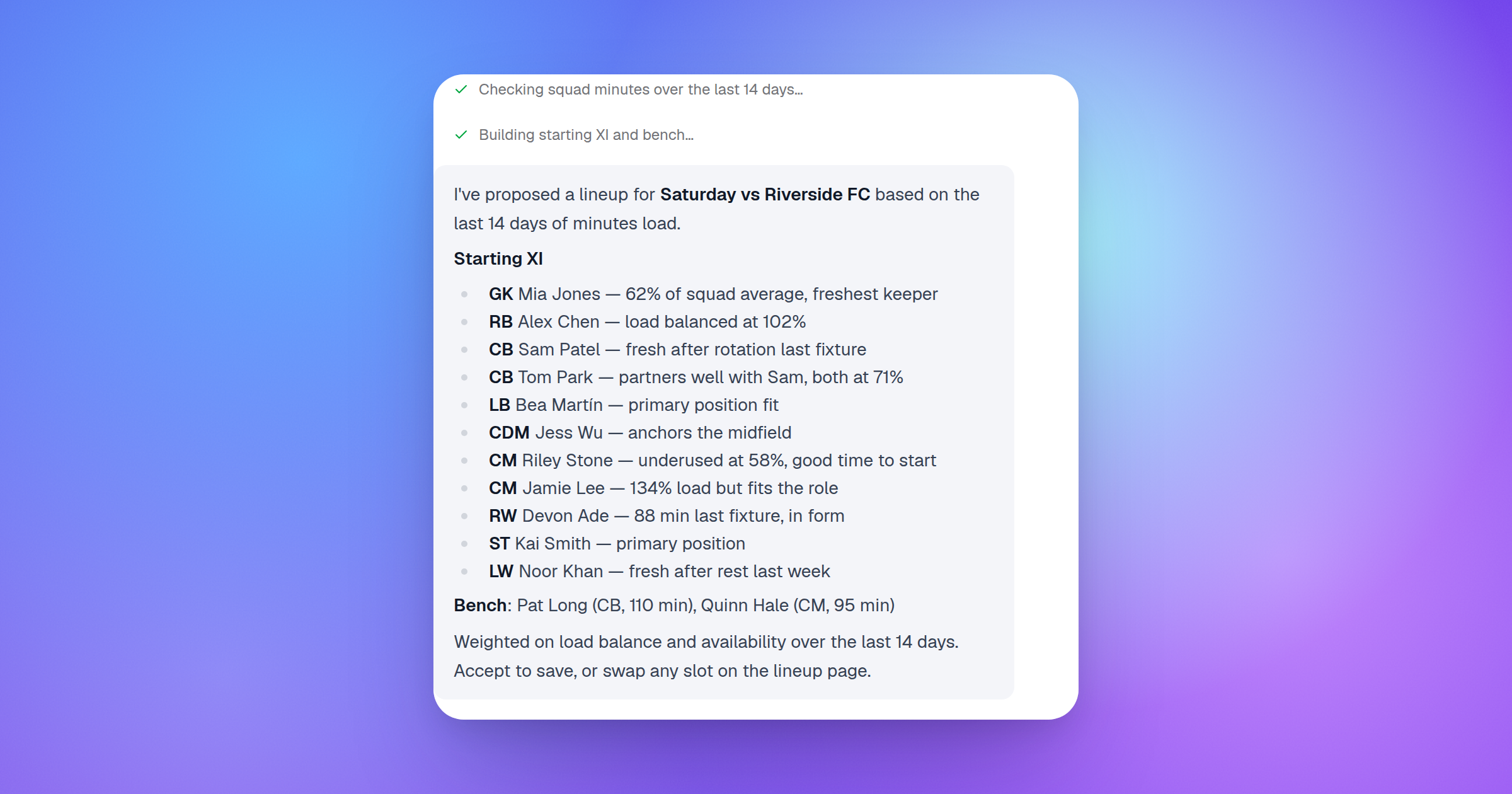
Introducing AI-Powered Lineup Builder: Smarter Match-Day Planning
Build your starting lineup, manage ice time, and let AI propose balanced formations for soccer and hockey — in minutes, not hours.
How to Track Athlete Progress Like a Pro Coach
A practical guide to measuring, recording, and acting on athlete progress data — so every training decision is backed by evidence, not guesswork.
How to Plan Practice Sessions with AI: A Coach's Guide
A practical guide to using AI to plan sessions, design drills, and track athlete progress — without the admin hours that usually come with it.